JAPANESE BULL (NR250)
DAI 14 SHIGERU 8994 (FB347)
JAPANESE COW (NR251)
DAI 7 ITOZAKURA (FB226)
JAPANESE BULL (NR250)
DAI 9 ITOZAKURA (FB395)
JAPANESE COW (NR251)
JAPANESE BULL (NR250)
HARUMI 9878 (FB565)
JAPANESE COW (NR251)
KITAGUNI 7 (FB580)
JAPANESE BULL (NR250)
MORINAKA (FB579)
JAPANESE COW (NR251)
THE High Selling Wagyu Bull of ALL TIME!
"The International Bull of Mystery"
BREED THEM or NEED THEM....
DAI 14 SHIGERU 8994 (FB347)
DAI 7 ITOZAKURA (FB226)
DAI 9 ITOZAKURA (FB395)
Sire: ITOHANA (FB504)
DAI 7 ITOZAKURA (FB226)
YOSHIFUKUHANA (FB561)
DAI 4 FUKUHANA (FB469)
HARUMI 9878 (FB565)
KENSEI 108 (FB209)
JAPANESE COW (NR251)
Dam: HANA FUJI 472029 (FB563)
ITOCHIYO 309 (FB566)
HANAYUU 158303 (FB564)
JAPANESE COW (NR251)
"Kenhanafuji" was one of the most promising young bulls Japan had ever produced when he was snatched away by US investors in the early 90's and exported to America...
"Right away when we saw that bull in Japan we knew he was the one we had to get!"
Bruce Hemmingsen, Ultimate Kobe Beef
How fortunate we are as a breeder community outside Japan to have access to the genetics of this legendary, spectacular, historic, genetically unique and x, y, z superlative, original import animal!
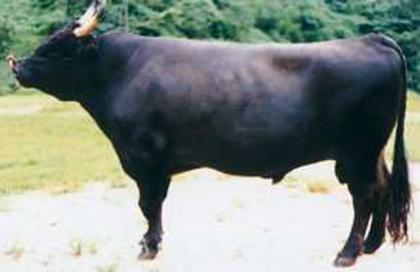
We've been unable to locate any existing pictures of Kenhanafuji, a curious oddity regarding the "International Bull of Mystery" and high selling wagyu bull of all time. The video above is of a fullblood black wagyu Kenhanafuji son in Brazil for phenotype reference. We have been able to verify that there is no red wagyu/akaushi blood or any commercial breed influence in the Kenhanafuji son above: he is an all-black fullblood! (Yes, there really is an elite marbling, full-blood black Wagyu bull that throws fullblood black Wagyu sons that look like that even when crossed on high Tajimas!)
Kenhanafuji was born December 16, 1993 in Japan. He was named after his tremendous, dynastic, Kedaka sired dam "Hanafuji," his former #1 in Japan marbling sire Itohana, and his 100% pure Kedaka Hongen maternal sire "Kensei." Kenhanafuji is the only calf out of the great Hanafuji cow ever registered outside Japan making him a potent out cross to all international herds worldwide, especially high Tajima herds!
In early 90's two world class cattlemen Yukio Kurosawatsu and Bruce Hemmingsen were sent to Japan and tasked by an investment group to canvas the country and pick out two elite wagyu bulls to bring back to America. Of the thousands of bulls they scrutinized up and down the islands from the top programs in Japan, Kenhanafuji made it easy to be #1 draft pick due to his freakish extreme phenotype and unrivaled, rockstar royalty, slap yo grandma pedigree marbling-wise. There were many breeders in Japan who did not want Kenhanafuji to leave the country and cross the Pacific ocean to be exploited by large scale American producers but Yukio and Bruce somehow "got it done," and Kenhanafuji and Takazakara miraculously made it over to states in one piece.
So why aren't there hundreds of registered full blood progeny sired by Kenhanafuji here in North America and around the world like there are of Takazakara?
Why is Kenhanafuji the rarest of all foundation bulls, (Mazda, Mt Fuji, 005, Judo and Rueshaw included!) with the American Wagyu Association herd book showing only 1 registered animal sired by him born in the last 15 years?
And why have most breeders never even heard of him?
One reason Kenhanafuji may be the rarest of all foundation bulls is simply due to fact that a pedigree without a picture is worse than dead. The answer may also partially lie in the fact that Hyogo is one of the few remaining genetically closed prefectures with regard to Wagyu breeding, and the man who purchased Kenhanafuji in America owned a wagyu breeding operation in Hyogo, Japan....
To the chagrin of many breeders in Hyogo, even to this day, they are not allowed to cross their pure Hyogo Tajima stock with any outside Kedaka/Shimane blood. This must be frustrating to some Hyogo breeders because high Kedaka x Shimane, low tajima bulls have now long since dominated the nationwide carcass contests in Japan for years. Imagine being on the inside of the Kobe beef industry in Japan, owning a large scale Wagyu operation in genetically restricted Hyogo and seeing an opportunity to finally seize access to a big bad bruising Kedaka/Shimane bull like "Kenhanafuji" that marbles as well as any Tajima, but who's carcasses are 20-30% larger, despite being fed several months less! Could this notion shed more light on the behind-the-scenes story of "The International Bull of Mystery?"
Kenhanafuji's value and uniqueness was expressed most succinctly by the actions of a notable Japanese Wagyu breeder Mr. Eiji Funatsuki, also a commercial high rise real estate developer in Tokyo and owner of a world class Wagyu operation in Hyogo, Japan (same place where Tajima Kobe Beef comes from). Mr Funatsuki, the proverbial "Donald Trump of Tokyo," followed the "Kenhanafuji" bull all the way to America and paid $150,000 cash for him on the spot! Some say he merely wanted to finally own and have access to the growth and maternal advantages of a zero-Tajima bull that marbled as well as any Tajima in Hyogo, with carcasses that weighed 20-30% more despite being fed several months less. Some say he felt like America stole the best bull in Japan at the time and he couldn't let the opportunity to own Kenhanafuji slip through his fingers. Others say he made a long term tactical maneuver to strategically block the budding international Wagyu beef producer community from gaining access to the competitive commercial edge this unique bull would give large commercial western beef operations outside Japan. Imagine if everyone in the Americas and Australia had marbling as good if not better than the low growth, low milk Tajimas of Hyogo, in a much higher growth, more milky, far more commercially viable Kedaka-Shimane package? Based on his management of the "International Bull of Mystery" after spending $150,000 purchasing him in the states, then basically sitting on him, perhaps the "Donald Trump of Tokyo" did all the above?
"Kenhanafuji" progeny hold the key to the answer for a few lucky breeders who get to work with them, but as of this writing, there are only perhaps two or three known living registered fullblood progeny in North America, and one of those, the great foundation cow KOBE MIZUTANI 607E (FB3214), turns 20 years old this year...
Much like Coke vs. Pepsi or Budweiser vs. Coors, personal preferences between major brands varies worldwide. Many Japanese consumers actually prefer Shimane marbling, fat quality and taste over Tajima. Some prefer specific strains of Tajima, Shimane or Kedaka, or specific combinations of the three main prefecture bloodlines over all the others. As one of the very few original import Bulls with ZERO Tajima blood, and the only original import bull with a 75% Fujiyoshi and 25% Kedaka genetic breakdown, "Kenhanafuji" has unique genetic capacity to compliment the same old worn out high Tajima genetics of most herds outside Japan with desperately needed heterosis, growth, frame, milk and that world famous Shimane marbling and delicious fat quality like no other bull can that we have access to. If one looked at different prefecture bloodlines like spices in a recipe book for the perfect steak, Kenhanafuji, along with Shigefuku J1822 would be one of the most powerfully potent Tajima diluters on the kitchen shelf...
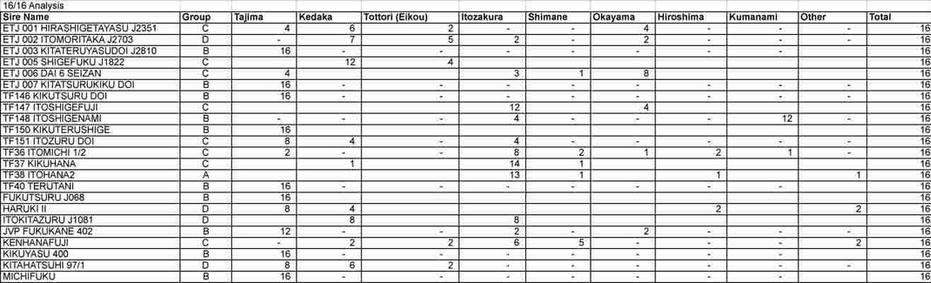
As you can see from the chart above borrowed from the Australian Wagyu Forum, there were numerous 100% Tajimas imported while very few pure Kedaka x Shimane bulls were selected at the peak of the Kobe-crazed days of the global industry, making the options we have to dilute Tajima blood down to fall more in line with western style commercial cattle production and the top animals in Japan today very limited.
Kenhanafuji's legendary Shimane sire Itohana was at one time the highest rated marbling sire of the entire country in Japan! Another Kedaka x Shimane bull to earn and hold this distinction is the great Grand Champion of the All-Japan Wagyu Zenkyo Competition "Kitaguni 7/8," who actually won the fabled "Superbowl" of all carcass contests twice! (Zenkyo is the world olympics of Wagyu carcass contests that takes place every five years.)
Kenhanafuji has a very similar pedigree to the legendary Kitaguni 7/8 bull in three key ways:
1) Dai 7 Itozakara on top of pedigree.
2) A Harumi line Kedaka cow on bottom of pedigree:
(Kedaka → Dai 2 Kedaka → Harumi→ Kensei)
3) 100% Kedaka x Shimane with ZERO TAJIMA!
DAI 14 SHIGERU 8994 (FB347)
DAI 7 ITOZAKURA (FB226)
DAI 9 ITOZAKURA (FB395)
ITOHANA (FB504)
DAI 7 ITOZAKURA (FB226)
YOSHIFUKUHANA (FB561)
DAI 4 FUKUHANA (FB469)
HARUMI 9878 (FB565)
KENSEI 108 (FB209)
JAPANESE COW (NR251)
HANA FUJI 472029 (FB563)
ITOCHIYO 309 (FB566)
HANAYUU 158303 (FB564)
JAPANESE COW (NR251)
The top 10 Bulls in Japan the past several years averaged more than 50% Kedaka, approximately 30% Shimane and less than 20% Tajima. This is almost the reverse opposite of the prefecture strain breakdown of most contemporary North American and Australian Wagyu herds today. Why did Japanese and international wagyu breeders focus so heavily on Tajima genetics for so long, even though Kedaka x Shimane carcasses have comparable marbling capacity and fat quality (for many even preferable marbling and fat quality), and are overall far more commercially viable, especially in the west due to growth and maternal characteristics?
Some say it was because PBS did a few specials on Kobe beef in the 80's, with footage of servants massaging little short and fat, black, beer-fed Tajima cattle whilst classical music played in their stalls all day. Thus the Kobe brand exploded worldwide due in no small part to the element of mythical mystique and media curiosity that amounted to gimmicky if not shrewd, viral marketing tactics, and the rest is history.
Japan went through the "high tajima phase" in the 80's and 90's that America is still going through. They have long since switched to Kedaka and Shimane blood with reckless abandon...but they focused on Tajima exclusively for so long, and stacked it on top of itself with everything everywhere for so many years, that zero Tajima animals like "Kenhanafuji" and the great Westholme bull Shigefuku J1822 became exceedingly rare if not extinct...even in Japan!
What do Japanese consumers and breeders know now that many US breeders still stuck in the 80's - 90's "Kobe" hyped high Tajima phase of the international Wagyu market don't?
As one of the very few ZERO tajima bulls to ever leave Japan (75% Shimane and 25% Kedaka), Kenhanafuji is one of the easiest ways to get from '90's bred high tajima cows to higher kedaka x shimane bloodline combinations more in line with the top prize winning, commercially viable animals in Japan today.
Could your herd stand to use a little non-Tajima heterosis from the high selling Wagyu bull of all time, to transform the ratio of your genetics to mirror the high kedaka/shimane animals of Japan that dominate their domestic industry today?
What could a few straws of the "International Bull of Mystery" do to the value trajectory of all your future calf crops?
Can a supposed "elite" seed stock operation of tomorrow afford to sit this one out and let others have all the fun?
BREED THEM or NEED THEM!
We all have to ask ourselves: why would a famous Wagyu breeder from high Tajima Hyogo, teeming with lifetime experience in the international Wagyu industry chase this zero Tajima bull across the World's largest ocean, pay a fortune for him, and then restrict his genetics?
We had Hawkeye Breeders, semen collection facility break a straw and examine semen quality from this batch of straws under a microscope and the results are in:
Uber high flush quality semen with 50 million+ cell count per straw collected when bull was young in the mid 90's. One could easily split straws of this stuff between 2 or 3 donors and still deliver more Semen to each donor than most of today's entire straws do. Collectors used far less extender back in the mid nineties when this bull was collected in his prime.
Here's your chance to get some curve bending high Kedaka/Shimane "Kenhanafujis" on the ground.
It used to be that the only zero Tajima, high Kedaka/Shimane bull we had access to the was the mighty original import 005 Shigefuku J1822, who's semen and embryos set all time records at the 2015 AWA sale in Florida. Now, for a very select few breeders who like to play with the hottest fire, there is another...
Imagine what semen and embryos from sons and daughters of this bull will be worth as the the true commercial value of high Kedaka and Shimane blood slowly dawns more and more on breeders outside of Japan like it already has inside?
What can the "International Bull of Mystery" do for you?
Who is ready to go nuclear and gain a seat at the elite summit of Wagyu world superpowers?
BREED THEM OR NEED THEM!
LIMITED QUANTITY AVAILABLE by private treaty.
Viability and parentage guaranteed.
CARRIER FREE!
Comments from some of the world's top wagyu breeders regarding Kenhanafuji:
"Kenhana what? Who?"
X, Y, Z Breeders
"Kenhanafuji as you might know was an original import from Japan that come in the second shipment that WKS did in 1994.
Kenhanafuji is sired by Itohana (one of the very few Fujiyoshi sires utilized for F1 breeding due to his marbling ability in Japan). Itohana had at one time ranked the highest for marbling of all sires ranked in Japan, a rare feat for a Fujiyoshi.
Itohana is comparable to the famous Kitaguni 7-8, transmitting the famous meat qualities of their sire Dai 7 Itozakura.
The breeding of Itohana to Hanafuji was a complimentary one, utilizing the size / stature and maternal ability from the maternal line while introducing the stabilizing influence of meat quality from Itohana which resulted in Kenhanafuji.
Kenhanafuji breeds as one would expect from the pedigree - strong, long bodied animals with extreme width. They are good milkers with high fertility, have great temperament and easy keeping cattle. Calves are jet black."
Ken Kurosawatsu, Wagyu Sekai Inc
"Right away when we saw that bull in Japan we knew he was the one we had to get!"
Bruce Hemmingsen, Ultimate Kobe Beef

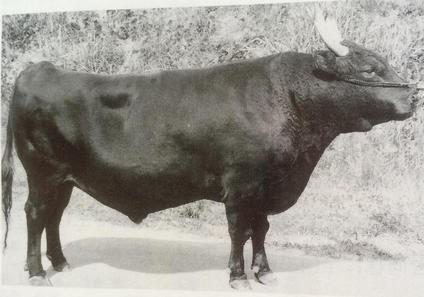
Dai 7 Itozakara (FB226)
Kenhanafuji's sire Itohana, one of the most famous, highest marbling sons of Dai 7 Itozakara in Japan, and his dam the great Kedaka-influenced Hanafuji cow, were considered more advanced improvements over the legendary Kitaguni 7/8's similarly bred sire and dam...one could almost think of Kenhanafuji as the new improved Kitaguni 7/8 on steroids, or as the new generation might say: "Kitaguni 2.0."
Elite Wagyu Genetics
"Wagyu: The King of Beef!"
Extreme marbling, milk and growth in one stunning outcross package like no other!

WagyuRanch.com
