WagyuRanch.com
Elite Wagyu Genetics
"Wagyu: The King of Beef!"
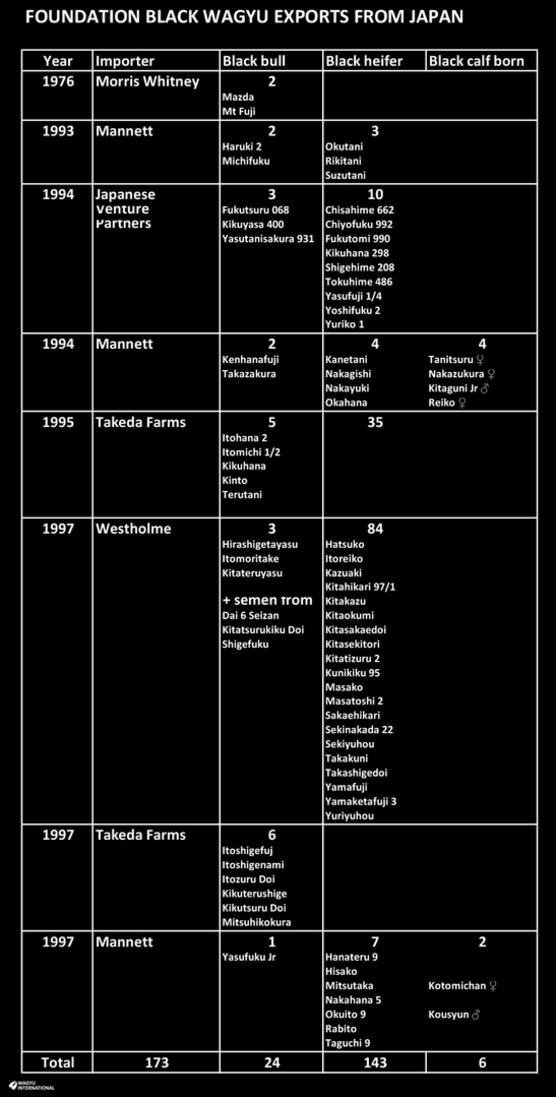
So what are wagyu and how did they get here from Japan? The following is an encyclopedic account of the history of all known Wagyu cattle importations to the United States in the words of an elite breeder who has been involved with the breed from the beginning:
"Let's get the story straight once and for all. Mannet (now operating as WKS) sent out their initial shipment of cattle in 1993 (this shipment consisted of Michifuku / Haruki 2 / Suzutani / Okutani / Rikitani). Before these animals were assembled for export, Mannet built their own quarantine barn per the specifications of the USDA and the Japanese MAFF, this facility was approved by both governments. Once the quarantine facility was approved, Mannet moved their cattle in. At the same time, Mannet was approached by Chuck O'Hara (through WSU) to allow for the use of the quarantine for the export of cattle Mr. O'Hara had assembled in Japan, Mannet agreed to allow Mr. O'Hara's cattle into the quarantine for a fee. When all these animals had passed their testing requirements and we're ready to leave Japan for the USA, Mr. O'Hara could not pay the agreed upon fee for the quarantine usage and Mannet subsequently "kicked" out Mr. O'Hara's cattle from quarantine, thus loosing their export status. Mannet then proceeded to export their five animals to the USA. Prior to arrival into the USA, Mannet established New Era Genetics with Buck Wright as the General Manager. Upon the arrival of the five animals to the USA, Mr. O'Hara started a lawsuit in the USA claiming that the five animals were his. After a long drawn out affair, a settlement was reached in Seattle where Mannet gave up the original import cow "Rikitani", 3 pregnancies (The pregnancies resulting in bulls, Kanadagene 100, Kanadagene 101 and one female - Kanadagene 102) + one purebred 63/64 cow called Patty + semen on Michifuku / Haruki 2. Since Mr. O'Hara did not have his own money and had CGMP (an early Wagyu company well known in the industry at the time) back him for the lawsuit, the animals all ended up in the ownership of the CGMP principals.
Black Wagyu Info & History
Wagyu Sekai purchased the first pregnancies from Mannet (4 pregnancies - Genjiro / Okuharu / Suzumichi / Rikiharu) purchased one ((Fujiko), and Mannet kept the remainder of the pregnancies (Sanjirou / Shigeshigetani / Beijirou / Takara).
Wally Rea from Overflow negotiated an exclusive 3 year deal with Mannet in an securing the first FB genetics into Australia (Mishashi / Oskar / Kaneyama / Katsumi). Unfortunately Wally did not get any females from the embryos he had purchased.
Mannet's second shipment + the Reds.
Bruce Hemmingsen was approached by Englewood (Al & Marie Woods) in 1993 about the possibility of exporting Red Wagyu out of Japan. Bruce approached my father Yukio (as the two had already had an established relationship with the Holstein breed of cattle) about the possibility of sourcing and exporting the Red Wagyu out of Japan. Yukio already had a great working relationship with the prefectural government of Kumamoto in exporting over 300 head of high quality Holsteins from both the USA and Canada over a four year period (these animals were purchased by the Kumamoto Government to coincide with the Dairy Zenkyo - Zenkyo is the all Japan show held for both dairy and beef every five years). Due to the relationship Yukio had with the government of Kumamto, he was able to select the Red Wagyu with Kumamoto's blessing and yes Bruce was with Yukio during the selection process.
The cow that was the prefectural gem was not Akiko. The cow was Dai 8 Marunami (mother of Tamamaru).
Since Yukio / Bruce did not have a quarantine facility to export the animals from Japan, Yukio with his prior relationship with Mannet got approval to include the Red Wagyu into Mannet's quarantine facility for a fee. The Red's and Mannet's blacks (Takazakura / Kenhanafuji / Nakayuki / Nakagishi 5 / Kanetani / Okahana) were all assembled together into the same quarantine.
Three Red Wagyu animals failed quarantine testing for Akabane / Ibaraki disease and quarantine was extended. When the animals finally were allowed to leave Japan, Bruce flew with the cattle to the USA, with a refuel in Alaska into JFK.
Yukio had the brainstorm to have these animals bred to the top bulls in Japan while in quarantine (resulting in Big Al, Kaedemaru, Momigimaru, an additional female - Dai 9 Kobai x Namimaru).
Yukio then sold the cow Dai 9 Kobai to Englewood upon clearing JFK quarantine.
The two remaining red cows owned outside of this shipment - Naomi and Dai 3 Namiaki Ni + the two offspring Kaedemaru and Momigimaru made their way to Canada with the remaining red's going to Englewood (who then became Heartbrand later on).
Due to the BSE outbreak in Japan, both Naomi and Dai 3 Namiaki Ni were order destroyed by the Canadian Government for BSE testing (this order also included Rikitani herself).
Mannet also sold the rights to Kenhanafuji to a Japanese investor, Eiji Funatsuki for $150,000 cash.
The JVP shipment followed after the second shipment of Mannet's.
Our red's were then all sold to two astute cattlemen who we know will breed these animals true.
JVP had two Red animals in their shipment: Kunisakae and Dai 27 Homare. As Dustin mentioned, I believe the former owner of Heartbrands cattle sold the genetics prior to being bought out.
My former boss at Mannet, Mr. Kaneyama constantly had many death threats prior to shipping the first shipment and many more after the shipments were made. It was a good thing he was "connected" or these shipments would never have happened. Many of a deal were made in the back rooms and lots of "fees" were paid. WSU and Buck Wright were instrumental in this side of the ocean to make this pipe dream become a reality."
There you have it folks!!!
"Wagyu" literally means "Japanese Cow" in Japanese. Although the term is used loosely to describe all cattle from Japan, there were actually four different breeds of cattle developed there:
Japanese Black (黒毛和種 Kuroge Washu), Japanese Brown (赤毛和種 Akage Washu or "Akaushi"), Japanese Polled (無角和種 Mukaku Washu), and Japanese Shorthorn (日本短角和種 Nihon Tankaku Washu).
A relatively long nation with highly variant elevation levels running latitudinally North to South, Japan has a wide range of climates and micro climates and distinct regional topographical characteristics. Since cattle were used for centuries regionally as draft animals, and selected for physical characteristics best suited for regional use, different sub strains of cattle emerged within the primary breeds.
The black wagyu make up over 90% of the fattened cattle in Japan. Strains of Japanese Black include Tottori, Tajima, Shimane and Okayama. Japanese Brown, also known as Japanese Red, or "Akaushi" is the other main breed; strains include Kochi and Kumamoto. Japanese Shorthorn makes up less than one percent of all cattle in Japan.
Wagyu cattle's genetic predisposition yields a beef that contains a higher percentage of omega-3 and omega-6 fatty acids than typical beef. The increased marbling also increases the ratio of monounsaturated fats to saturated fats.
Australia
The Australian Wagyu Association is the largest breed association outside Japan. Both fullblood and Wagyu-cross cattle are farmed in Australia for domestic and overseas markets, including Taiwan, China, Hong Kong, Singapore, Indonesia, the U.K., France, Germany, Denmark and the U.S. Australian Wagyu cattle are grain fed for the last 300–500 days of production. Wagyu bred in Western Australia's Margaret River region often have red wine added to their feed as well.
United States
In the United States, Japanese Wagyu cattle are bred with Angus cattle. This crossbreed has been named American Style Kobe Beef. Wagyu were first competitively exhibited at the National Western Stock Show in 2012. Some U.S. Wagyu breeders have full blooded animals directly descended from original Japanese bloodlines, and are registered through the American Wagyu Association.
Canada
Wagyu cattle farming in Canada appeared after 1991 when the Canadian Wagyu Association was formed. Wagyu style cattle and farms in Canada are found only in Alberta, Ontario and Prince Edward Island. Canadian Wagyu beef products are exported to the U.S., Australia, New Zealand, Hawaii and Europe.
Scotland
The firm Highland Wagyu was established in 2011 and is based at Blackford Farms in Dunblane, Scotland. The company acquired a herd of 300 Wagyu cattle to add to its existing herd of 250 in July 2013 and became the largest producer of Fullblood Wagyu beef in the UK with plans to make Scotland the Wagyu centre of Europe.
<iframe src="https://www.facebook.com/plugins/post.php?href=https%3A%2F%2Fwww.facebook.com%2FWagyuRanch%2Fposts%2F1823857997829542&width=500" width="500" height="739" style="border:none;overflow:hidden" scrolling="no" frameborder="0" allowTransparency="true"></iframe>